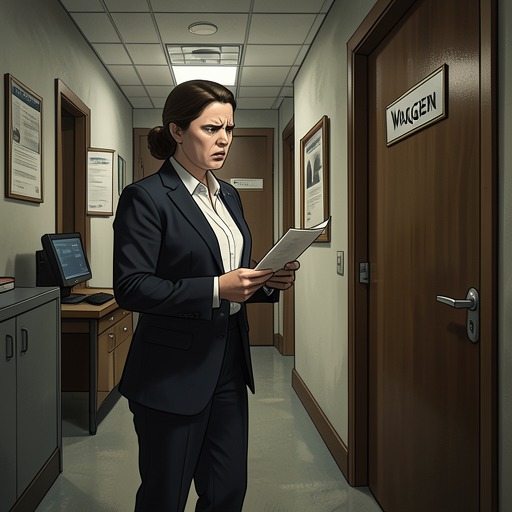
Nella Rogers
The Other Black GirlNella Rogers is an assistant editor at Wagner Books whose attempt to build a career while challenging the publishing house’s racial assumptions becomes entangled with a covert effort to alter her behavior. Her arc moves from the ordinary pressures of office work and promotion to anonymous warnings, evidence implicating Richard Wagner, and a final attempt to carry what she knows beyond Wagner under the name Delilah Henson.
Identity and Introduction
Nella has worked for Vera Parini, one of Wagner’s most exalted editors, for two years. She entered the job without much experience of a Manhattan office: before Wagner, she had worked behind bars and coffee counters, where she encountered people across occupations and could wear what she liked. For her interview with Vera, she knew she could not simply arrive in a Black Lives Matter shirt. The adjustment to professional office life therefore began with a calculation about which parts of herself the setting would permit her to display.
Her first anxieties were practical as well as social. She worried about MTA mishaps, getting lost, and whether a run in the crotch of her stockings would survive another wear. But she also feared that the severe hierarchy, homogeneity, and rigidity she had seen in television and films might describe the real workplace. Those expectations give her later conflicts a context: the question is not merely whether she can perform an assistant’s tasks, but how much conformity the job will demand of her.
A sensory detail marks one early encounter: the first sign was the smell of cocoa butter. The brief observation makes Black hair and its products part of Nella’s workplace world before the conflict around them becomes explicit. Later, her own appearance and her understanding of hair grease will be bound up with the question of whether her choices remain her own.
Work, Ambition, and Speaking Up
Nella’s relationship with Vera becomes strained around the prospect of advancement. At their anniversary check-in, Nella asks for a promotion; Vera responds with a list of grievances about her performance, ending with the complaint, “I wish you’d put half the effort you put into those extracurricular diversity meetings into working on the core requirements.” Nella looks at papers she still has not delivered and reflects that the speed of carrying something from one point to another should not determine whether she deserves to become an assistant editor. The scene puts a supposedly routine measure of office competence beside a more consequential rebuke: her participation in diversity meetings is being treated as evidence against her professional focus.
That tension also shapes Nella’s response to Colin Franklin’s portrayal of Shartricia Daniels. She begins her criticism cautiously, announcing that there is “one thing” she thinks could use work; the hesitation registers the risk she feels in challenging a colleague. She worries that Colin will hear a criticism of his work as an accusation of racism. Her concern is informed by what she has overheard after Wagner’s Diversity Town Halls: employees discussing the prospect of being forced to hire nonwhite people and suggesting that such hires would be unqualified. The hostility is not abstract to her; it helps explain why making a specific editorial objection can feel like entering a broader argument about who belongs in publishing.
Nella also recognizes that her experiences are not readily legible to Owen. During a conversation at home, she pauses with a stick of deodorant in hand and reflects that, as a white cis man, he will not share many of the conversations she has unless they have children. She expects him to regard Wagner’s behavior and microaggressions as harmless compared with other workplaces. The contrast does not establish that Owen dismisses every concern; it shows the gap Nella anticipates between her daily reading of the office and the more distant perspective available to him.
Warnings, Suspicion, and Evidence
The anonymous threat “LEAVE WAGNER. NOW.” turns Nella’s unease into a direct question of safety and trust. She entertains the possibility that Hazel-May McCall planted the letter, and the suspicion follows her into an evening with Malaika. After two drinks, the thought becomes more consuming; by the third, Nella is eager to take out her phone when Malaika asks whether she has friended her new coworker. Their earlier conversation about whether Boyz n the Hood could become a stage musical has run out, and the suspected connection to Hazel supplies an anxious new focus.
Nella tells someone that a strange note arrived, then later admits to Hazel-May that she has been receiving odd notes from an anonymous person, trying to sound casual. At another point she considers speaking to Richard Wagner about the Colin incident. Before going to him, she checks Colin’s Twitter account to see whether he has told his five hundred thousand followers about it. She doubts Richard knows what happened, and knows that raising it without a reason could expose her position unnecessarily. Her hesitation is not simple passivity: she is weighing the danger of silence against the risk of making herself vulnerable to a powerful employer without knowing what he already knows.
The decisive shift comes when Nella examines a page allotted to a woman whose photograph appears with a hot-pink sticky note: “Seems complacent enough; but more efforts won’t hurt—order of 8 jars coming in 10/20.” The page is larger than the row given to the other women. Nella recognizes the handwriting from Richard’s contracts and holiday cards: “Richard. This is Richard’s handwriting.” The note’s reference to an order of eight jars, alongside Richard’s familiar script, gives her suspicion a concrete material clue. The date attached to the order is October 20, 2018, a detail that connects the page to the broader plan rather than leaving it as an isolated office document.
Resistance, Transformation, and Ending
Nella’s plan to get out of Wagner takes shape with Malaika. When Hazel-May asks why Nella came to work, Nella feigns ignorance: the plan, made with Malaika the night before, is to meet Jesse Watson, show him everything on Nella’s phone, leave Wagner with him, and never look back. Her answer conceals a course of action that depends on transferring evidence beyond the company. The contrast between her outward explanation and the private plan shows how far caution has become necessary to her strategy.
By the time Nella looks at herself in the mirror, she can measure changes in her habits. She has not checked Facebook in weeks, has stopped sharing links about Black issues on Twitter for weeks or perhaps months, and has declined Owen’s invitation to a documentary about wrongful incarceration at BAM, citing work. These are concrete losses of ordinary activity and connection, not merely a change in attitude. When she asks herself what she sees, the mirror makes the absence visible; her realization that the answer was “never” leaves the precise preceding question unstated, but gives the moment a note of despair rather than reassurance.
Hazel-May explains that she, too, was an Involuntary and says she was pulled out of Boston and assigned to Nella because they were alike. She describes Nella as someone who wanted “to get along to get along,” and recalls that even after Hazel publicly annihilated her, Nella did not crack. Hazel says she had been told Nella was tough and smart and claims to recognize those qualities now. The revelation recasts Hazel’s earlier proximity to Nella as part of an assignment, while also exposing a point of identification between them: Hazel presents Nella’s endurance and desire to fit in as the very traits that made her susceptible.
Nella’s final move is not to return to ordinary work under her own name. At Scope, she introduces herself to the women there as “I’m Delilah Henson—Gwen’s interim replacement,” running her fingers through the back of a full lace weave. When she addresses Shani Edmonds, Nella comes closer, puts a hand on Shani’s shoulder, and asks, “What’s it really like here? You can be real with me, sis.” The practiced welcome recalls the language and manner of an insider, but Nella now uses that familiarity while presenting a constructed identity. Her arrival as Delilah carries her beyond Wagner’s walls, yet the closing exchange leaves her in a position that is still precarious: she must approach another Black woman through a disguise while trying to learn what is happening around her.